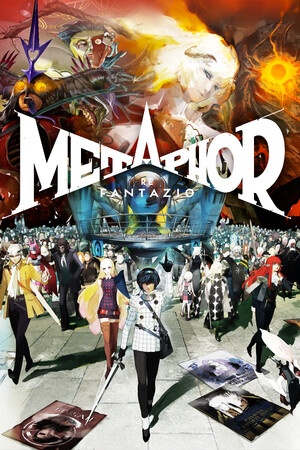
Metaphor: ReFantazio review: Atlus builds a fantasy worth believing in
A long, literary JRPG that treats the wish for a fairer world as the bravest thing a person can hold.

The Scorecard
There is a moment early in Metaphor: ReFantazio when the protagonist reads a novel that the whole kingdom dismisses as a children's fantasy, a book about a world without discrimination, without fear, without the poison of tribal hatred. He reads it, and he believes in it, and the entire game is built on the ache of that belief. I sat with that for a long time. This is a story about people who dare to imagine a fairer world while living inside a rotten one, and Atlus never lets you forget how naive and how necessary that hope is. It is the theme that hooks you, and it is the theme that holds.
The company you keep here is the reason I kept turning pages. Your fairy companion Gallica, sharp and wounded and funny, becomes the voice that keeps the fantasy honest. Strohl, Hulkenberg, the wary mage Heismay, the whole traveling party carry their prejudices and griefs openly, and the writing gives each of them room to change rather than simply confess. What moved me most is how the game treats reactivity of the heart rather than the plot: the confidant-style bonds do not just unlock abilities, they slowly teach these people to trust across the very racial lines the world weaponizes. The voice acting is committed and unshowy, the localization is some of the most graceful I have read in a JRPG, and the pathos lands because it is earned in small scenes, over meals, on the road, in the quiet after a loss. Critics were right to call the worldbuilding epic. I would add that it is also intimate, which is harder.
The systems underneath serve that fantasy with real elegance. The Archetype class system is the engine of your roleplay: each companion awakens jobs drawn from their own convictions, and building a party becomes a way of expressing who these people are becoming. Reviewers widely praised the combat as one of the most innovative turn-based designs in years, a careful synthesis of Persona and Shin Megami Tensei, and I agree. It rewards investigation of every enemy, their weaknesses and strengths, with a press-turn rhythm that makes knowledge itself feel powerful. The calendar returns too, that familiar Atlus pressure of finite days, and here it doubles as a thematic clock counting down to an election that will decide the kingdom's soul. Build expression and the systemic depth are considerable, yet what I admire is restraint: the mechanics never upstage the people. They are scaffolding for the archetype of the hero the game is quietly asking you to become.
Where it falters is honest and worth naming, because a strong game still owes players the truth. The dungeon design is the weak thread. Too many corridors blur into one another, and around the forty hour mark the repetition of layout and visual language began to tire me, a criticism many reviewers shared. The pacing is the other nuance. Metaphor is eager, sometimes more aggressive than Persona in shoving you forward, and elsewhere it lingers in exposition until the momentum sags. Some longtime fans will feel the Archetype system, for all its cleverness, lacks the collectible charisma of catching Personas. None of this is fatal. But it costs you hours, and you should know that going in.
What stays with me is the belief. Metaphor: ReFantazio arrived to near universal acclaim, a 94 on both Metacritic and OpenCritic that ties it with Persona 5 Royal among the finest the genre has produced, and having lived inside it I understand that number. It is not a flawless game. Its dungeons wander and its pace stumbles. But it is a profoundly humane one, a fantasy that treats the wish for a better world as the bravest thing a person can hold. Who is it for? For anyone who wants a long, literary JRPG that cares as much about its characters' convictions as its combat math, for players who read the codex twice and cry at the quiet scenes, and for anyone still willing to believe that imagining fairness is the first step toward building it. I believed it. I think you will too.